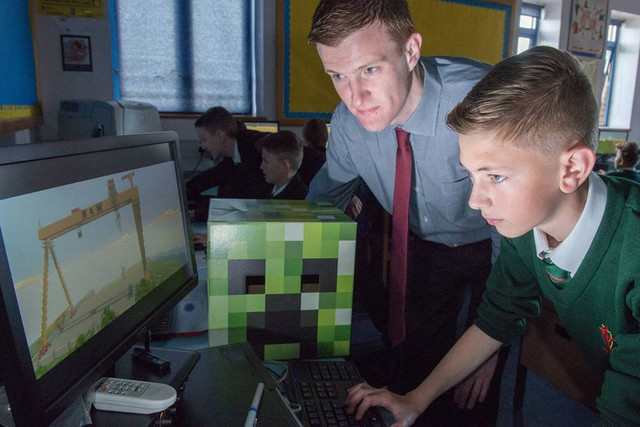

New research on game-based learning shows that games can impact positively on problem solving skills, motivation and engagement.
In a new study, conducted by The National Foundation for Educational Research in England and Wales (NFER) found that game-based learning shows that “games can impact positively on problem solving skills, motivation and engagement.” The researchers from (NFER) write that;
“The role of video games in teaching and learning is a source of debate among many educators, researchers and in the popular press. Detractors and advocates have been discussing the influences and the potentials of video games for quite some time, and we feel that sound evidence and informed advice on these topics is still very much needed. Against this background, Futurelab at NFER felt that it was timely to provide practitioners, industry and researchers with an up-to-date account of what the evidence tells us about game-based learning and its potential impact on learning and teaching. The review aims to bridge academic and non academic domains, to provide insights that will be of interest to educators, educational researchers, industry and others seeking to engage in a more thoughtful debate about the types of educational values that can be attached to gaming. In particular, we provide accessible advice for practitioners, in the belief that innovation in education is always underpinned by informed and critical teaching.
We carried out a rapid review of key literature to identify relevant theoretical contributions and evidence. This involved systematic searching and a consistent, best evidence, approach to the selection of the literature. We focused on a range of sources, including empirical, practice-based evidence and more speculative literature, published from 2006 onward.
The main findings are as follows:
- The literature was split on the extent to which video games can impact upon overall academic performance.
- The studies consistently found that video games can impact positively on problem solving skills, motivation and engagement. However, it was unclear whether this impact could be sustained over time.
- Despite some promising results, the current literature does not evidence adequately the presumed link between motivation, attitude to learning and learning outcomes. Overall, the strength of the evidence was often affected by the research design or lack of information about the research design.”
Perrotta, C., Featherstone, G., Aston, H. and Houghton, E. (2013). Game-based Learning: Latest Evidence and Future Directions. Slough: NFER.
To a download a free copy of this research click here;
http://www.nfer.ac.uk/publications/GAME01
Related articles
- Game Based Learning Introductory Reading List (gamedlearning.com)
- Games Based Learning through Text Adventures (gamingandeducationengagementinlearning.com)
Brainy Fables Premium Apps Engage Children into Learning with Games and Original Karaoke Songs

“Brainy Fables is the first series of book apps for children 4-7 aimed at developing creative thinking through storytelling
Brainy Fables is the first series of apps for kids aged 4-7 aimed at developing children’s creative thinking through storytelling, games and karaoke songs.
Five (5) Brainy Fables’ characters will guide children through the world of life skills and abilities such as: creative thinking, reaching “to the stars”, believing in yourself, problem solving, overcoming fear, capacity to take action and trying one’s best.
By reading, playing, singing, and talking about the challenges of Marcelo, Mirta and all the great Brainy Fables characters, children will have an opportunity to learn and practice English/Spanish language while discovering valuable lessons.
Each Premium app includes an interactive fable, two mini games and an original karaoke song and video with our Brainy Fables’ friends as the leading characters. Each of those elements will help parents and teachers bring positive messages into story time in a fun environment. “Night time, we are tired and we want our children to go to bed”, says author Franco Soldi, “but, what better way to do so than by having a nice and enriching conversation with our children with the help of one of our Brainy characters?”
Brainy Fables’ adventures have been lived up with music specifically created for each character. Rock, pop, country, salsa fusion or ethnic pop music is the vehicle for children to enjoy and learn in an entertaining atmosphere.
Every fable offers charming illustrations, animation and various features that enhance the reading experience – narrated or read myself options, hidden sounds and interactions, a summary of the story’s lesson, coloring pages, the ability for children to write and save their own ending to the story and a page for parents & teachers to help discuss the story’s message for children.
Brainy Fables are available in the iTunes Store and in Google Play and include Horacio the piglet, Mirta the super fly, Uxmal and the pyramid challenge, Marcelo the fox and Matias the rebellious chick.
ABOUT THE AUTHOR AND NEXT STAGE PRODUCTIONS:
Author Franco Soldi is a father, creator and communications expert who has focused much of his career on empowerment of youth and bringing ideas to life. As a founding partner at YPD Group and Next Stage, Franco Soldi works to create educational content for teens and children of the 21st century. Next Stage Productions is the developer of the Brainy Fables series and a growing slate of other upcoming entertainment properties.”
- – -
It is good to see game developers focusing on critical thinking skills.
- – -
Brainy Fables son una experiencia educativa y divertida para niños entre cuatro y siete años. Las apps, preciosamente ilustradas, utilizan el formato de la fábula clásica en cada cuento para transmitir un mensaje universal sobre el valor del pensamiento creativo para lograr objetivos.
Anima a Marcelo, Uxmal y sus amigos coloreando sus aventuras.

Franco Soldi es el autor de Brainy Fables y padre de dos niños. Trabaja con jóvenes pre-universitarios en ‘Young Potential Development’ desde hace años y ahora Franco escribe para los más pequeños de la casa.
Pedro Bascón ha ilustrado Brainy Fables convertiendo cada aventura en una experiencia visual para niños y padres. Pedro trabaja como ilustrador desde hace diez años especializándose en el ámbito de la educación y la infancia.
Brainy Fables apps han sido desarrolladas por la productora y distribuidora madrileña Next Stage.
For more information on current apps, visit http://www.brainyfables.com.
3 Things I Wish Everyone Knew about Gamification
Reblogged from Remixing College English:
The Games-Based Learning MOOC is coming to an end (technically, at least, but I'm sure that many of us will continue to share ideas and resources since the MOOC is based upon the constructivism learning theory and uses Lisa Dawley's Social Knowledge Network Construction method). The last week also happens to coincide with my preparations to present on my use of immersive role-play and Second Life in my Spring FYC II class at my university's…
LeapFrog’s Jake And The Never Land Pirates Game Wins First Ever “ON For Learning Award” From Common Sense Media
LeapFrog game honored by Common Sense Media for its engaging and educational content for kids.
- My four year old son loves this game on the iPad. -
EMERYVILLE, Calif., March 26, 2013 /PRNewswire/ –
LeapFrog Enterprises, Inc. (NYSE: LF), the leader in educational entertainment, today announced its LeapFrog learning game Jake and the Never Land Pirates received a 2013 ON for Learning Award from Common Sense Media, the national nonprofit dedicated to helping parents and teachers manage the media and technology in kids’ lives. This esteemed honor is given to the top kids’ media products that received the highest rating for learning potential from Common Sense Media. Jake and the Never Land Pirates is available in LeapFrog’s vast library of learning games, apps, eBooks, videos, music and more for the #1 kids’ learning tablets, LeapPad1™ and LeapPad2™, and learning video game systems, Leapster Explorer™ and LeapsterGS™.
(Logo: http://photos.prnewswire.com/prnh/20090219/LFLOGO)
The Common Sense Media ON for Learning Awards celebrate the best in kids’ digital media, and are based on the organization’s Learning Ratings Initiative which launched this year. The Learning Ratings Initiative is designed to help parents sort through the abundance of apps, games and websites that claim to be educational and surface products that deliver on learning potential and are age appropriate based on a ratings system of “ON,” “PAUSE” and “OFF.” LeapFrog’s Jake and the Never Land Pirates game received the initiative’s highest learning rating based on robust educational research from leading experts in both education and digital media at Common Sense Media.
“It is a privilege to receive recognition for our learning solutions from such a well-recognized resource as Common Sense Media,” said John Barbour , chief executive officer at LeapFrog. “Our highly experienced team of learning experts worked tirelessly to develop and design the Jake and the Never Land Pirates game to ensure it was age-appropriate for kids and provided an exciting introduction to math. Common Sense Media is a leader in identifying age-appropriate multimedia content and this award is another validation that LeapFrog learning solutions consistently deliver top-quality educational entertainment.”
Jake and the Never Land Pirates is available for LeapPad learning tablets and LeapFrog learning video game systems for the three to five age group. The game is designed to provide kids an introduction to foundational math skills by distinguishing letters from numbers, sorting and classifying objects, recognizing the defining properties of shapes and counting, and comparing sets of objects as they embark on adventures with Jake and his friends. Jake and the Never Land Pirates is part of the LeapFrog library of more than 500 learning games, apps, eBooks, videos, music and more, all reviewed and approved by LeapFrog’s highly experienced team of learning experts.
“Jake and the Never Land Pirates exceeded our expectations for its ability to engage and educate preschoolers about math,” said Seeta Pai , vice president, research and digital content at Common Sense Media, and head of the Learning Ratings Initiative. “We were especially impressed with the variety of gameplay to keep kids engaged in their learning.”
Jake and the Never Land Pirates (MSRP $24.99, for children ages 3-5) is currently available at major retail locations and at www.leapfrog.com. For more information visit www.leapfrog.com.
About LeapFrog
LeapFrog Enterprises, Inc. is the leader in educational entertainment for children. LeapFrog’s award-winning product portfolio helps millions of children achieve their potential by delivering best-in-class curriculum through engaging content, fun multimedia learning platforms and toys. The Learning Path, LeapFrog’s proprietary online destination for parents and extended family, provides personalized feedback on a child’s learning progress and offers product recommendations to enhance each child’s learning experience. Through the power of play, LeapFrog’s products and curriculum help children of all ages prepare for school and life success. LeapFrog’s products are available in more than 45 countries and have been used by teachers in more than 100,000 U.S. classrooms. LeapFrog is based in Emeryville, California, and was founded in 1995 by a father who revolutionized technology-based learning solutions to help his child learn how to read. Come see the learning at www.leapfrog.com.
TM & © 2012 LeapFrog Enterprises, Inc. All rights reserved.
| Media Contacts: | |
| Monica Ma | Kathryn Green |
| LeapFrog Enterprises, Inc. | LeapFrog Enterprises, Inc. |
| 510-596-3437 | 510-596-3405 |
| mma@leapfrog.com | kgreen@leapfrog.com |
SOURCE LeapFrog Enterprises, Inc.
RELATED LINKS
http://www.leapfrog.com
Games Based Learning through Text Adventures
Reblogged from Remixing College English:
This week in the Games Based Learning MOOC, we've been focusing on two tools for GBL: AR/ARGs and Interactive Fiction/Text Adventures. As I've mentioned in a previous post, I'm planning to integrate IF into my Fall FYC class. Students will both experience the course as a piece of IF and, at the end of the term, create their own IF.
13 Of The Best Special Needs Apps of 2012 (#edapps)
by Teachers With Apps, published on TeachThought : 13 Of The Best Special Needs Apps of 2012
TeachThought and TWA are pleased to bring you another ‘Best of 2012′ app list: 13 Of The Best Special Needs Apps of 2012!
1. See. Touch.Learn. Pro by Brain Parade is one app that can have many purposes, including creating your own lessons.
Fun, Flow, and Fiero: Reflections on Week 1 of the Games Based Learning MOOC
Reblogged from Remixing College English:
As mentioned in my last post, I am planning to gamify next Fall's first-semester FYC course, using Interactive Fiction (IF) and the multiplayer classroom model. The decision to do so came completely independently of a new MOOC that started this past week that focuses on Games Based Learning (GBL). I had not intended to take this MOOC, since I had already signed up for another MOOC that would overlap with it.
References
Delwiche, A. (2006). Massively multiplayer online games (MMOs) in the new media classroom. Journal of Educational Technology & Society, 9(3), 160-172. de Freitas, S. (2006). Learning in immersive worlds: A review of game-based learning. JISC. 148 Dickey, M. (2006). Game Design Narrative for Learning: Appropriating Adventure Game Design Narrative Devices and Techniques for the Design of Interactive Learning Environments. Educational Technology Research & Development, 54(3), 245-263. Hansen, L., & Sanders, S. (2010). Fifth Grade Students’ Experiences Participating in Active Gaming in Physical Education: The Persistence to Game. The ICHPER-SD Journal of Research in Health, Physical Education, Recreation, Sport & Dance, 5(2), 7.Good Games Are Hard: in a Fun Way
-
In her article “Teachers, Students, Digital Games: What’s the Right Mix?” Holly Korbey interviewed a few educators who had some bad ideas about computer games;
“And learning is hard work. The tools children use to manipulate and
change the world and their own neural pathways should reflect the
profundity of that phenomenon; we should have some blisters, form
calluses, break a sweat. Computer games don’t demand that from
children.”
No.
The better games are demanding. That is why they are the best games. There are educational games that are very challenging but they are challenging in the way that good play is challenging. It is counter productive to remind children that they learning not playing. The best learning happens when we are playing.
Practicing a skill leads to success, but if the practice is boring then students will be less motivated to engage in the requisite practice (James Gee, 2007). The best digital games provide practice that is very compelling, engaging, and challenging, but never boring. Gamers play not because games are easy but because they are hard. But, they are hard in the right way, to the right degree, and most importantly – they are hard in a fun way. The best games provide the balance of challenge and support. To describe learning as “hard work and not play” is one of the worst possible ways to describe it.
Gee, J.P. (2007). What video games have to teach us about learning and literacy (Rev. ed.). New York: Palgrave McMillian.To read the full article by Holly Korbey click here;
Two New Game-Based Learning MOOCs
Reblogged from Educating Lotus:
You might like to know about two game-based learning MOOCs (massively open online courses) that you can sign up for now. Like all MOOCs they are free and the level of participation is up to you.
Games MOOC III. When you click this link, you’ll see the following overview of the course and can then look around this well-developed site to see if all or parts of the course (and its delivery modes) interest you.